35×70 House Plan: 10 Marla House Map, Naksha and 3D Front Elevation
35×70 House Plan: Complete Plot Size and Design Guide
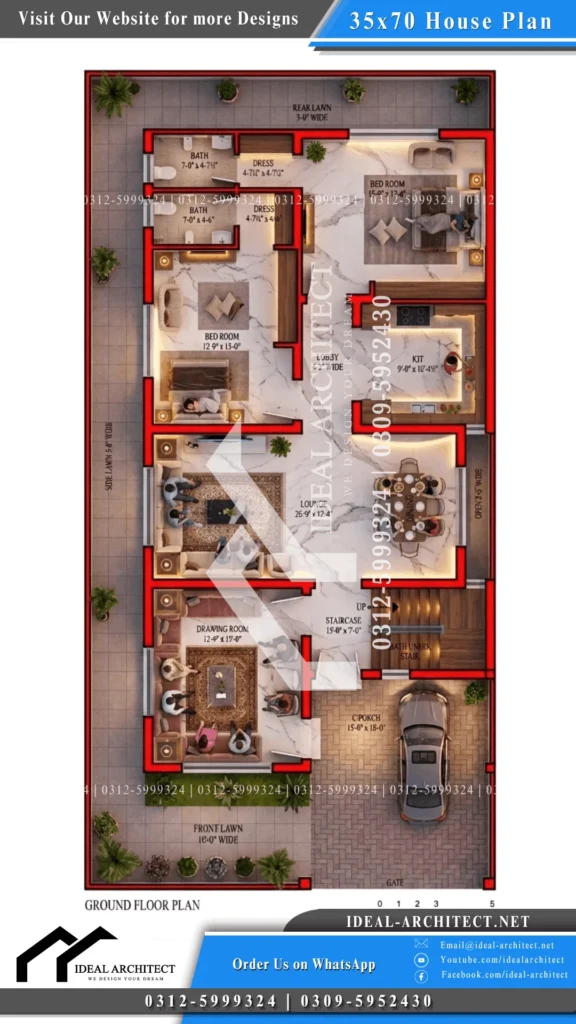
A 35×70 house plan gives a Pakistani family something that smaller plots simply cannot — the depth to separate a guest’s world from a family’s world without either feeling cramped. The 35-foot width handles the car porch, the front lawn, and the drawing room side by side at the entrance. The 70-foot depth pushes the private bedrooms so far back from the street that road noise, guest conversations, and front-door activity become genuinely irrelevant by the time you reach the rear of the home. That combination — manageable width, serious depth — is exactly why the 35×70 house design has become one of the most consistently chosen footprints for double-story residential construction across Pakistan’s major housing schemes.
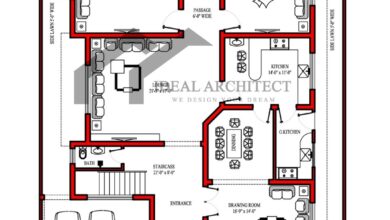
This 35×70 house plan is built around one central planning principle: public spaces transition naturally into private spaces without a single awkward crossover point. Guests arrive, are received, and leave entirely through the front zone. Family members move through the center and the rear without ever sharing a path with visitors. That separation does not happen by accident — it is the result of every room being placed for a reason rather than wherever space happened to allow it.
35×70 House Design: Car Porch, Front Lawn and Entry Sequence
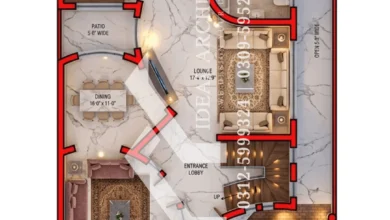
The first thing this 35×70 house design establishes at street level is a clear split between the guest path and the family path — and it does this before anyone even steps inside. The car porch at 15 feet by 18 feet sits at the front right of the plot, providing deep covered parking for a full-sized vehicle with enough clearance for door swing on all sides. Anti-skid porcelain tiles or stamped concrete flooring handle daily vehicle traffic cleanly, while weather-proof recessed LED spotlights in the porch ceiling ensure the arrival experience works equally well at night. The boundary wall on the porch side can carry low-profile built-in cabinets for automotive tools and outdoor maintenance equipment without consuming any of the main house’s storage.
To the left of the car porch, a 10-foot-wide front lawn spans the full forward boundary of the property. This is not decorative padding — it is an environmental buffer that reduces street noise before it reaches the drawing room, improves air quality before it enters the interior, and gives the drawing room’s front-facing windows a pleasant green view throughout the day. Manicured turf with architectural accent uplighting along perimeter planting and a low stone retaining border keeps this space looking deliberate rather than incidental. The front lawn also gives children a safe, contained outdoor zone within the boundary wall — something that a zero-setback plot simply cannot provide.
From the car porch, guests step directly left into the drawing room without touching the main family entrance. Family members step straight into the staircase tower and the central living spaces. These two paths never intersect — and that invisible separation is what makes daily life in this 35×70 house plan feel effortless rather than managed.
35 by 70 House Plan: Drawing Room and Guest Zone
The drawing room in this 35 by 70 house plan measures 12 feet 9 inches by 15 feet and occupies the front left corner of the main structure — the position that gives it the most natural light, the most pleasant outlook, and the cleanest separation from the private rear of the home. A massive front window looks directly onto the 10-foot front lawn. A long side window looks out over the 5-foot side lawn. Together these two windows create a cross-ventilated, naturally bright space that feels airy and open regardless of how many people are seated inside.
At 12 feet 9 inches by 15 feet, the room comfortably holds a large L-shaped or traditional 7-seater formal sofa arrangement centered around a main coffee table, with room along the interior walls for accent consoles and display niches. Premium hardwood flooring or polished marble tile, an elegant accent wall with sophisticated wood molding, and a statement chandelier give the room a formal register that matches its function without requiring excessive decoration.
The critical planning advantage here is dual entry. Guests enter from the porch side directly. The room also connects internally to the central lounge for family movement. This means the drawing room can operate as a completely sealed formal space during visits — with guests entering, being entertained, and leaving without ever seeing the kitchen, the bedrooms, or the rear of the house — while remaining naturally integrated into the family’s daily circulation at all other times.
35×70 House Map: Staircase Tower and Central Circulation
The staircase tower in this 35×70 house map measures 15 feet by 7 feet and sits immediately adjacent to the car porch at the main family entrance. This placement is one of the most consequential decisions in the entire plan — and it is one that most standard layouts get wrong by placing the staircase deep inside the home where it forces upper-floor residents to pass through the family living spaces to enter or exit.
Here, the staircase is positioned at the outermost edge of the private family zone, right off the porch. A future upper residential unit — whether for extended family, grown children, or rental — can be accessed directly from the car porch without anyone on the ground floor ever being aware of the movement. Heavy-duty granite or polished stone step treads with a contemporary glass or wrought-iron railing system handle the vertical circulation elegantly. The area under the staircase is converted into a powder room for guests — one of the most practical uses of structural dead space in residential planning, ensuring visitors never need to enter the private bedroom corridor to access a bathroom.
35×70 Plot: Central Lounge and Dining Area
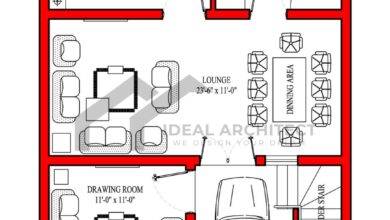
The lounge and dining area in this 35×70 plot layout measures 26 feet by 12 feet 6 inches and runs across the absolute center of the floor plan. At 26 feet in length, this is a genuinely expansive space — long enough to divide clearly into a family lounge on the left and a formal dining zone on the right without either half feeling tight or secondary. Large-format light grey porcelain tiles across the entire central floor make the space feel even larger than it is. A minimalist drop ceiling with integrated warm LED strip lighting subtly defines the lounge and dining zones without physical walls, keeping the visual openness of the space intact.
The left side of the lounge faces a wide window bay looking out over the 5-foot side lawn — one of two ventilation corridors built into this 35×70 house design. Natural light and fresh air enter from this side throughout the day. The right side of the dining zone sits adjacent to a 2-foot 6-inch open lightwell that vents the dining and kitchen areas simultaneously. These two openings on opposite sides of the central core create a continuous cross-breeze that eliminates the stuffiness that typically plagues the middle section of a deep urban plot.
Every room on the ground floor connects to this lounge naturally — the drawing room, the staircase foyer, the kitchen, the rear bedroom lobby — making it the true distribution hub of the home. Long floor-to-ceiling built-in credenzas or modern media consoles along the lounge wall provide storage for linens, electronics, and everyday items without cluttering the visual openness of the space.
35×70 House Design: Kitchen Layout and Service Flow
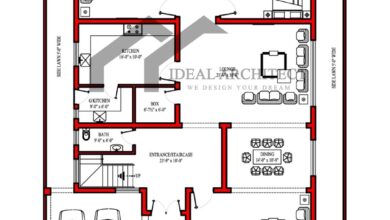
The kitchen in this 35×70 house design measures 9 feet by 10 feet 4 and a half inches and sits on the right side of the plan, directly adjacent to the dining half of the central lounge. Its position is deliberately chosen for two reasons: serving distance and service separation. From the kitchen counter to the dining table is the shortest possible path — meal service requires no traversal of living spaces or corridors. At the same time, the kitchen connects through a rear secondary door to the private bedroom lobby, which means grocery deliveries, staff movement, and kitchen-related traffic can move between the service entrance and the culinary zone without passing through the family lounge at any point.
A U-shaped or L-shaped countertop layout maximizes workspace along three walls, keeping the sink, cooking range, and refrigerator within an ergonomic triangle that works without unnecessary movement. The main sink sits naturally beneath the large side window opening onto the 2-foot 6-inch open courtyard — natural light for food preparation during the day, instant clearance of cooking steam and heat through the opening at all times. Sleek handle-less acrylic cabinets, quartz countertops, and a geometric tile backsplash keep the finishes hardworking and easy to maintain. Full-height pantry towers and overhead cabinets running to the ceiling maximize storage without consuming counter space.
35×70 House Plan: Private Bedroom Suites and Rear Zone
The rear half of this 35×70 house plan is reserved exclusively for private family use, accessed through a 4-foot 3-inch-wide central lobby that branches left and right to the two bedroom suites. This short lobby is the only corridor in the entire ground floor — deliberately minimal, deliberately positioned as far from the front guest zone as the plan allows.
The left bedroom suite measures 12 feet by 15 feet. Neutral calming wall tones, rich laminate wood flooring, and low-profile recessed ceiling lights suit a space intended for sleep and quiet. A dedicated dress alcove at 4 feet 7 and a half inches by 4 feet 6 inches keeps all wardrobe storage completely out of the main bedroom area — no free-standing wardrobes, no visual clutter. The attached bathroom at 7 feet by 4 feet 6 inches features an elongated water closet, a wide vanity sink, and a dedicated shower stall, ventilated through a dedicated high window opening directly onto the side lawn.
The master bedroom on the right measures 15 feet 9 inches by 12 feet 6 inches — the largest single room in the ground floor plan and the most private position on the entire plot. Wide windows and glazed doors look directly out over the 5-foot rear lawn, drenching the space in soft indirect daylight and giving direct outdoor access to the backyard without passing through any other room. A plush upholstered headboard wall, elegant drapery, and warm ambient lighting fixtures give this room the luxury register its size warrants. The walk-in dress alcove at 4 feet 7 and a half inches by 4 feet 7 and a half inches provides generous floor-to-ceiling custom wardrobe space. The attached master bathroom at 7 feet by 4 feet 7 and a half inches includes a premium water closet, wide under-counter vanity, and a spacious walk-in shower area, ventilated directly onto the rear lawn.
Ventilation Corridors and Open Areas
This 35×70 house plan treats cross-ventilation as a structural commitment rather than an afterthought. Four dedicated open zones work together to keep every room on the ground floor naturally fresh throughout the year. The 10-foot front lawn buffers the street and feeds morning air into the drawing room and entrance. The 5-foot side lawn runs the full left boundary, supplying the drawing room, the lounge, and the left bedroom with continuous lateral airflow. The 2-foot 6-inch right courtyard vents the dining zone and kitchen directly, clearing cooking heat and steam without mechanical assistance. The 5-foot rear lawn feeds fresh air into both bedroom suites and their attached bathrooms from the back of the plot.
Together these four openings eliminate every dark zone and stuffy pocket that typically appears in deep urban residential layouts. The result is a home where air conditioning supplements comfort rather than substituting for absent natural ventilation — a distinction that shows clearly in monthly electricity bills and in the daily sense of how the house feels to live in.
35×70 House Plan Room Size Summary
| Room / Area | Dimensions | Key Feature |
|---|---|---|
| Car Porch | 15′-0″ × 18′-0″ | Deep covered parking, direct connection to porch and staircase |
| Front Lawn | 10′-0″ Wide | Street buffer, curb appeal, drawing room light |
| Drawing Room | 12′-9″ × 15′-0″ | Dual entry — porch and lounge, front and side lawn windows |
| Staircase Tower | 15′-0″ × 7′-0″ | Independent upper floor access, powder room beneath |
| Lounge and Dining | 26′-0″ × 12′-6″ | Central hub, side lawn and courtyard ventilation both sides |
| Kitchen | 9′-0″ × 10′-4½” | U-shaped layout, courtyard window, dual access to dining and lobby |
| Rear Lobby | 4′-3″ Wide | Private transition to both bedroom suites |
| Left Bedroom | 12′-0″ × 15′-0″ | Side lawn window, dedicated dress alcove, en-suite bath |
| Left Dress | 4′-7½” × 4′-6″ | Wardrobe zone isolated from sleeping area |
| Left Bathroom | 7′-0″ × 4′-6″ | Side lawn ventilation, water closet, vanity, shower |
| Master Bedroom | 15′-9″ × 12′-6″ | Rear lawn view, glazed doors, largest room on floor |
| Master Dress | 4′-7½” × 4′-7½” | Walk-in wardrobe, master suite transition |
| Master Bathroom | 7′-0″ × 4′-7½” | Rear lawn ventilation, premium fixtures throughout |
| Side Lawn | 5′-0″ Wide | Full left boundary, ventilation for lounge and left bedroom |
| Right Courtyard | 2′-6″ Wide | Dining and kitchen ventilation lightwell |
| Rear Lawn | 5′-0″ Wide | Both bedroom suites, outdoor access, back boundary privacy |
10 Marla House Map: Complete Layout, Ground Floor and 4 Bedroom Design
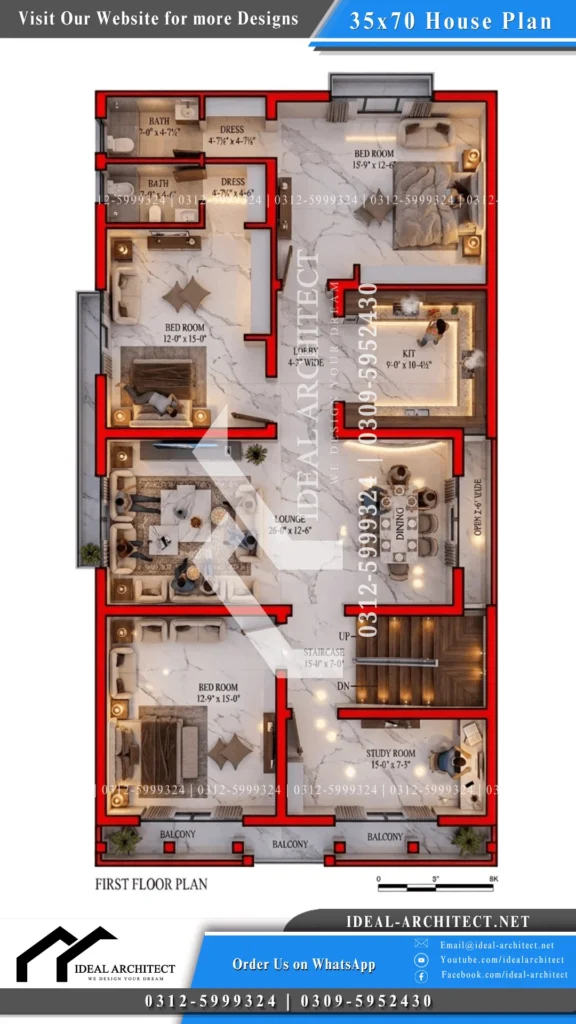
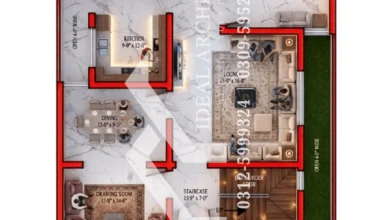
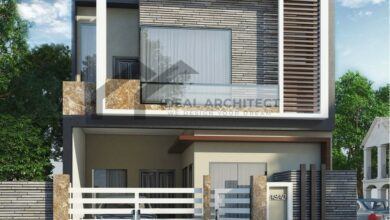
A genuinely well-planned 10 marla house map does not simply stack rooms on top of the ground floor — it reimagines what each zone of the plot can do at an elevated level. The upper floor of this 10 marla house layout transforms the footprint completely. The car porch roof becomes a study room and a front bedroom with balcony access. The drawing room below becomes a premium street-facing bedroom suite. The ground floor guest zone becomes an entirely private residential level with its own lounge, kitchen, and three bedrooms — fully capable of functioning as an independent unit without any connection to the floor below.
This is what separates a thoughtful 4 bedroom 10 marla house plan from one that simply adds rooms wherever space allows. Every decision on this upper floor has a structural reason — wet zones stacked above wet zones to keep plumbing vertical and cost-effective, load-bearing walls aligned to eliminate transfer beams, bedroom positions chosen for acoustic separation rather than convenience. The result is an upper floor that feels as considered and complete as the ground floor beneath it.
10 Marla House Map Design: Front Bedroom and Study Room
The two front rooms of this 10 marla house map design occupy the space directly above the ground floor car porch and drawing room — converting what is structurally the easiest zone to build over into two of the most desirable rooms on the upper floor.
The front bedroom at 12 feet 9 inches by 15 feet sits at the front left corner, directly above the ground floor drawing room. Its position above the drawing room means all load-bearing walls stack perfectly — no transfer beams, no structural complications. A massive front window structure and glass door system open directly onto the front balcony, giving this bedroom the best street view and the most natural morning light of any room on this level. Soft premium hardwood flooring, minimalist drop ceiling with hidden warm spotlighting, and floor-to-ceiling drapes over the balcony doors give the room a finish that matches its premium position. A king-sized bed sits comfortably against the internal partition wall with twin nightstands and a media console facing it.
The study room at 15 feet by 7 feet 3 inches occupies the front right corner — directly above the ground floor car porch. Converting porch roof space into usable interior square footage is one of the most efficient moves available in a 10 marla house layout, and this study room executes it cleanly. Its elongated proportions suit a long executive desk layout with floating bookshelves along the rear wall and comfortable study armchairs at the window end. Rich wooden wall paneling, built-in library cabinets, and cool-toned task lighting boost the focus and productivity the room is designed for. Its direct access from the staircase landing means an occupant can go straight from the front door to a working desk without passing through the family lounge — a separation that becomes genuinely valuable in a household where multiple people work or study from home.
Both front rooms share a wide front balcony that spans the full width of the car porch below. This balcony is the most visually prominent feature of the upper floor from the street — it establishes the elevation’s horizontal language, provides a sheltered outdoor zone for the front suite and study, and gives the property a strong architectural presence that a flat parapet simply cannot match.
10 Marla House Layout: Central Lounge and Dining Hub
The central lounge and dining area on this upper floor measures 26 feet by 12 feet 6 inches — identical in footprint to the ground floor lounge below. That vertical alignment is not coincidental. Keeping the lounge footprint identical on both levels means the long-span structural beams running along the perimeter walls of the ground floor lounge carry directly upward without any horizontal redistribution of loads. Construction cost goes down. Structural integrity goes up. And the family on the upper floor gets the same generously proportioned living and dining space as the household below.
At 26 feet long, the lounge divides naturally into a media and family seating zone on the left and a formal 6-seater dining arrangement on the right. Large polished neutral porcelain tiles across the full floor plane make the combined space feel even wider than it is. Modern geometric false ceiling details with integrated warm LED lighting define the lounge and dining zones without physical walls — a detail that keeps the visual openness of the space intact regardless of how it is furnished.
Cross-ventilation on this upper floor is handled through the same two openings as the level below. Wide left side windows bring fresh air in from the 5-foot side lawn boundary. The 2-foot 6-inch right-side open shaft feeds light and ventilation into the dining zone and kitchen simultaneously. Because these openings are now at an elevated level, they catch more consistent airflow than the ground floor versions — the upper floor of a 10 marla house map design in Pakistan almost always benefits from better natural ventilation than the level below, and this layout takes full advantage of that.
Every room on the upper floor connects back to this central lounge — the staircase foyer, the front bedroom, the study room, the kitchen, the rear bedroom lobby. Zero dedicated corridors. Zero wasted square footage. The lounge functions as the circulation hub that makes the rest of the 10 marla house layout feel open and naturally connected rather than compartmentalized.
10 Marla House Map with 3 Bedroom: Kitchen and Rear Suite Access
The kitchen on the upper floor measures 9 feet by 10 feet 4 and a half inches and mirrors the ground floor kitchen in both position and dimension — stacked directly above it for the most cost-effective plumbing configuration available in a double-story residential build. Every water supply point, every drainage outlet, every gas connection runs vertically from its ground floor counterpart without any horizontal branching through the structural slab. Pipe runs are shorter, material cost goes down, and future maintenance never requires opening a slab.
High-gloss laminate cabinetry, seamless quartz worktops, and an easy-to-clean ceramic tile backsplash keep the kitchen hardworking and easy to maintain. A U-shaped counter setup maximizes workspace along three walls. The kitchen window opens directly into the 2-foot 6-inch open-air shaft — cooking aromas and heat clear instantly without any mechanical assistance. A rear door connects the kitchen directly to the private bedroom lobby, keeping grocery movement and kitchen traffic entirely separate from the central lounge and dining area.
This kitchen is what makes the upper floor function as a complete, self-contained residential unit. Families using this level independently — whether extended family, grown children, or tenants — never need to access the ground floor for any daily function. The 10 marla house map with 3 bedroom configuration across the upper level, combined with this independent kitchen and the 26-foot lounge, delivers a residential standard that most standalone apartments in Pakistan cannot match.
The 4-foot 3-inch rear lobby branches left and right from the kitchen exit to the two rear bedroom suites. This short corridor is the only dedicated circulation passage on the upper floor — deliberately minimal, deliberately positioned at the deepest point of the plan to create maximum acoustic separation between the active lounge and dining zone and the private sleeping quarters.
4 Bedroom 10 Marla House Plan: Rear Bedroom Suites
The rear left bedroom measures 12 feet by 15 feet and occupies the quietest position on the left side of the upper floor. Wide side-facing windows bring in soft indirect daylight and consistent airflow from the left boundary setback. A king-sized bed arrangement with accent seating near the window fits comfortably with real clearance on all sides. The dedicated dress alcove at 4 feet 7 and a half inches by 4 feet 6 inches keeps all wardrobe storage entirely outside the main sleeping area — no free-standing wardrobes, no visual clutter disrupting the room’s generous proportions. The attached bathroom at 7 feet by 4 feet 6 inches includes an elongated water closet, a wide vanity sink, and a glass-enclosed walk-in shower, ventilated through a high external window.
The rear right master bedroom at 15 feet 9 inches by 12 feet 6 inches is the largest bedroom on the upper floor and the most private position in the entire 4 bedroom 10 marla house plan. It sits at the furthest point from the staircase, the street, and the front balcony activity — a position that makes it genuinely quiet at all hours regardless of what is happening elsewhere in the house. Wide rear-facing windows flood the room with soft natural light. A feature wall with modern textural wallpaper or warm wood trims, accented by soft dimmable LED ambient lighting, gives the room a luxury register appropriate for a master suite at this level. The walk-in dress alcove at 4 feet 7 and a half inches by 4 feet 7 and a half inches provides generous floor-to-ceiling custom wardrobe space. The attached master bathroom at 7 feet by 4 feet 7 and a half inches includes premium water closet, wide under-counter vanity, and a spacious walk-in shower — ventilated through rear external window openings.
When the ground floor’s two bedrooms are combined with this upper floor’s three bedrooms — front bedroom, rear left, and rear right — the complete 10 marla house map delivers five bedrooms across two fully independent floors, each floor with its own lounge, kitchen, and attached bathrooms for every bedroom. That is the functional definition of a well-executed ten marla house map.
10 Marla Map Design: Structural and Planning Advantages
The upper floor of this 10 marla map design achieves something that most residential layouts at this scale fail to deliver — every planning decision carries a structural benefit alongside its spatial one. Wet zones stacked vertically above their ground floor counterparts keep plumbing concentrated and cost-effective. Load-bearing walls aligned on both levels eliminate transfer beams entirely. The 2-foot 6-inch right-side shaft creates a thermal chimney effect that draws cool air through the central lounge and vents accumulated heat out efficiently — reducing air conditioning load on the upper floor in ways that pay back across every summer for the life of the building.
The front balcony spanning the full width above the car porch roof adds significant architectural depth to the elevation from the street. It establishes a strong horizontal line at the upper level that balances the vertical emphasis of the staircase tower and creates the kind of facade composition that photographs well, maintains its quality over decades, and adds measurable value to the property at resale.
The staircase tower at 15 feet by 7 feet positioned at the front of the plan ensures the upper floor can be closed off and operated entirely independently at any point — a feature that matters enormously when a family is deciding whether to use the upper floor for extended family, for grown children returning home, or for rental income. No structural modification. No shared access point. The upper floor is simply closed at the landing and functions as a separate address.
10 Marla House Plan Ground Floor to Upper Floor: Complete Room Size Summary
| Room / Area | Dimensions | Key Feature |
|---|---|---|
| Front Bedroom | 12′-9″ × 15′-0″ | Front left, balcony access, above drawing room |
| Study Room | 15′-0″ × 7′-3″ | Front right, above car porch, direct staircase access |
| Front Balcony | Full porch width | Shared outdoor zone for front bedroom and study |
| Staircase Tower | 15′-0″ × 7′-0″ | Independent upper floor access, connects to roof |
| Central Lounge and Dining | 26′-0″ × 12′-6″ | Mirrors ground floor, zero corridor waste, central hub |
| Kitchen | 9′-0″ × 10′-4½” | Stacked above lower kitchen, vertical plumbing |
| Rear Lobby | 4′-3″ Wide | Acoustic buffer between lounge and bedrooms |
| Rear Left Bedroom | 12′-0″ × 15′-0″ | Quiet left side, side window, dress alcove and bath |
| Left Dress | 4′-7½” × 4′-6″ | Wardrobe storage isolated from sleeping area |
| Left Bathroom | 7′-0″ × 4′-6″ | En-suite, external window ventilation |
| Rear Right Master | 15′-9″ × 12′-6″ | Largest room, maximum privacy, rear window |
| Right Dress | 4′-7½” × 4′-7½” | Walk-in wardrobe, master suite transition |
| Right Bathroom | 7′-0″ × 4′-7½” | Premium fixtures, rear external ventilation |
| Open Air Shaft | 2′-6″ Wide | Dining and kitchen ventilation, thermal chimney |
10 Marla Ghar Ka Naksha: Complete Naqsha aur Home Naksha Guide
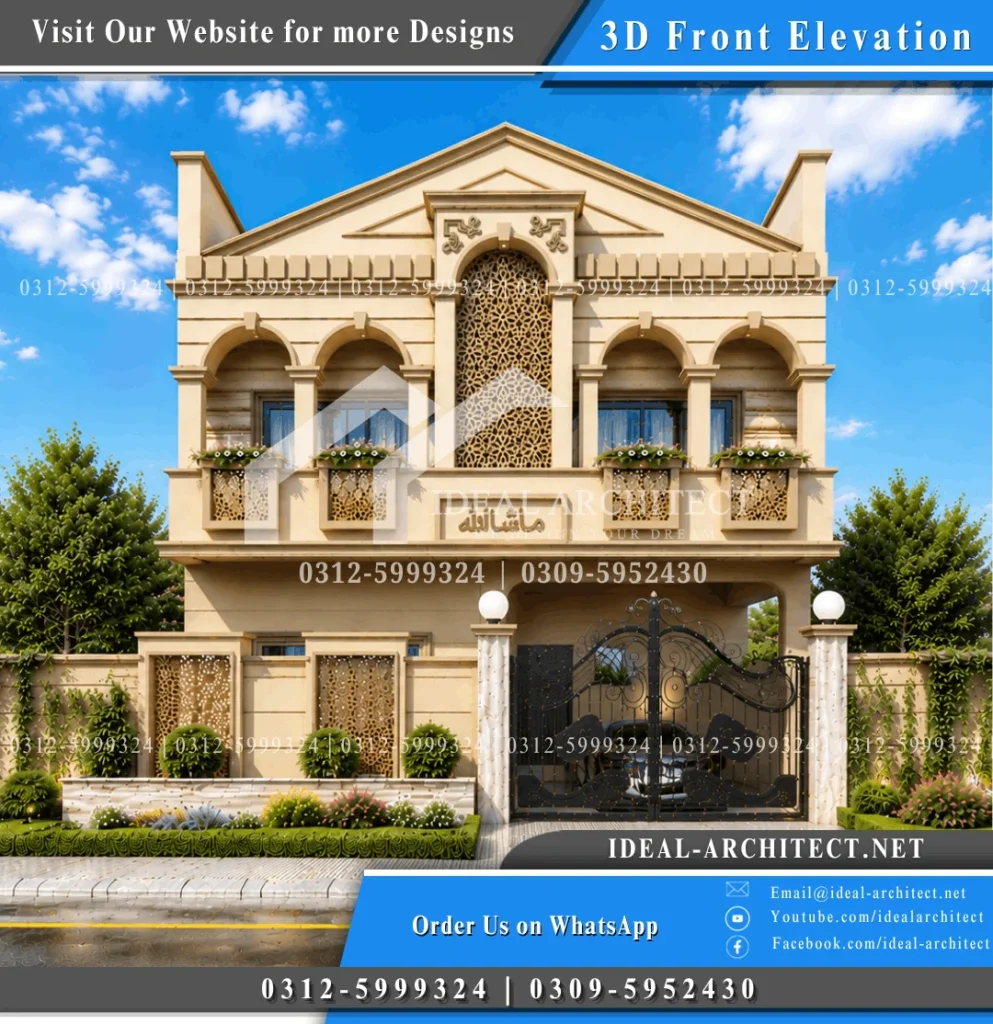
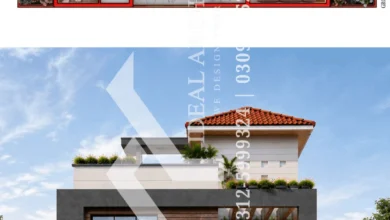
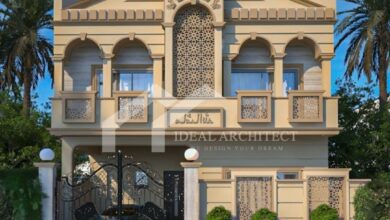
When a Pakistani family decides to build, the conversation almost always starts with the outside — what will the house look like from the street. But the outside of a home only makes sense when it grows from a 10 marla ghar ka naksha that has been planned properly from the inside out. The elevation shown here does exactly that. Every arch, every screen, every balcony planter corresponds to a room behind it — and the quality of what the street sees is a direct consequence of how well the interior naqsha house 10 marla was resolved before the facade was ever designed.
The architectural language of this 10 marla house naqsha Pakistan is Neo-Classical Islamic Fusion — a style that draws on the formal symmetry and structural discipline of classical architecture while embedding traditional Islamic motifs throughout the surface treatment. The result avoids two equally common failures in Pakistani residential design: the cold sterility of purely modern flat-roofed structures and the excessive ornamentation of historic revival styles that feel dated within a decade. This home naksha 10 marla occupies the space between both — structured, symmetrical and culturally grounded without being heavy-handed.
The massing of this 10 marla plot ka naksha is box-like in its base footprint but broken up vertically through a series of recessed voids, projecting balconies and a central feature bay that draws the eye upward and holds it there. The facade is formally symmetrical across the upper level — a quality that gives the elevation an immediate sense of order and stability when read from the street — anchored by a magnificent central arch that serves as the visual climax of the entire composition.
Naqsha House 10 Marla — Central Feature Bay aur Symmetrical Composition
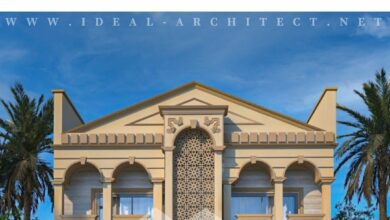
The dominant element of this naqsha house 10 marla is the deeply recessed central archway at the upper level, enclosed by an intricate geometric Jali screen in gold-toned CNC-cut aluminium. Above this central arch sits a classical triangular pediment with stylized dentils and stepped corbels beneath the roofline — an architectural reference to classical European facades, reinterpreted here within a distinctly Pakistani residential context. It anchors the roofline and provides the building silhouette with a strong, confident vertical termination point that is visible from a significant distance along the street.
Flanking the central screen on both sides are two pairs of perfect round arches, each supported by square structural pilasters with detailed base and capital moldings. These arches shelter large window openings beneath them — the depth of the recessed alcoves providing essential solar shading that prevents direct sunlight from striking the glass while creating beautiful shifting shadow lines across the facade throughout the day. Beneath each of the four upper arches sits an integrated Juliet balcony with an intricate gold-toned geometric screen acting as the safety balustrade, topped with planter boxes carrying pink and white flowering plants. The introduction of this organic colour and texture at the mid-level of the house naksha 10 marla prevents the stone-toned masonry from reading as heavy or monotonous at the height where the eye naturally settles when looking at the building from the pavement.
Positioned below the central Jali screen, a dedicated rectangular architectural frame encloses a beautifully rendered Arabic calligraphy inscription. In a 10 marla plot naqsha designed for a Pakistani family, this panel carries both spiritual and personal significance — it bridges the formal upper residential zone and the structural ground level while giving the facade a centrepiece that is entirely unique to this home.
Home Naksha 10 Marla — Boundary Wall, Gate aur Landscaping
The boundary wall and gate of this home naksha 10 marla are designed as a continuation of the main house rather than a separate structure placed in front of it. The gate profile follows the arched language of the main elevation — curving upward toward the centre to create a majestic portal for arriving vehicles — constructed from wrought iron in matte black with polished gold structural accents and fluid curved filigree work. The gateway is flanked by robust stone-textured columns topped with smooth spherical globe light fixtures that provide clear ambient illumination for the driveway while functioning as welcoming beacons visible from the street.
The boundary wall extending to the left is treated as an architectural surface in its own right. Rather than a blank barrier, it incorporates two large rectangular recessed niches filled with backlit geometric screens that match the upper floor’s central Jali motif — an extension of the design language rather than an interruption of it. The remainder of the wall features clean horizontal linear grooves that break the long surface and provide a contemporary backdrop for the climbing evergreen ivy and manicured shrubbery planted along the base.
The landscaping across this 10 marla ghar ka naksha front boundary uses a multi-tiered arrangement — low-clipped boxwood hedges at the front, a middle row of colourful seasonal flowers, and climbing ivy scaling the wall behind them. This layering does several things simultaneously: it softens the concrete surfaces at street level, reduces ambient dust from entering the property, and gives the house a natural ground connection that purely hard-paved frontages cannot achieve.
10 Marla House Plan 3D and Front Elevation: Modern and Spanish Design
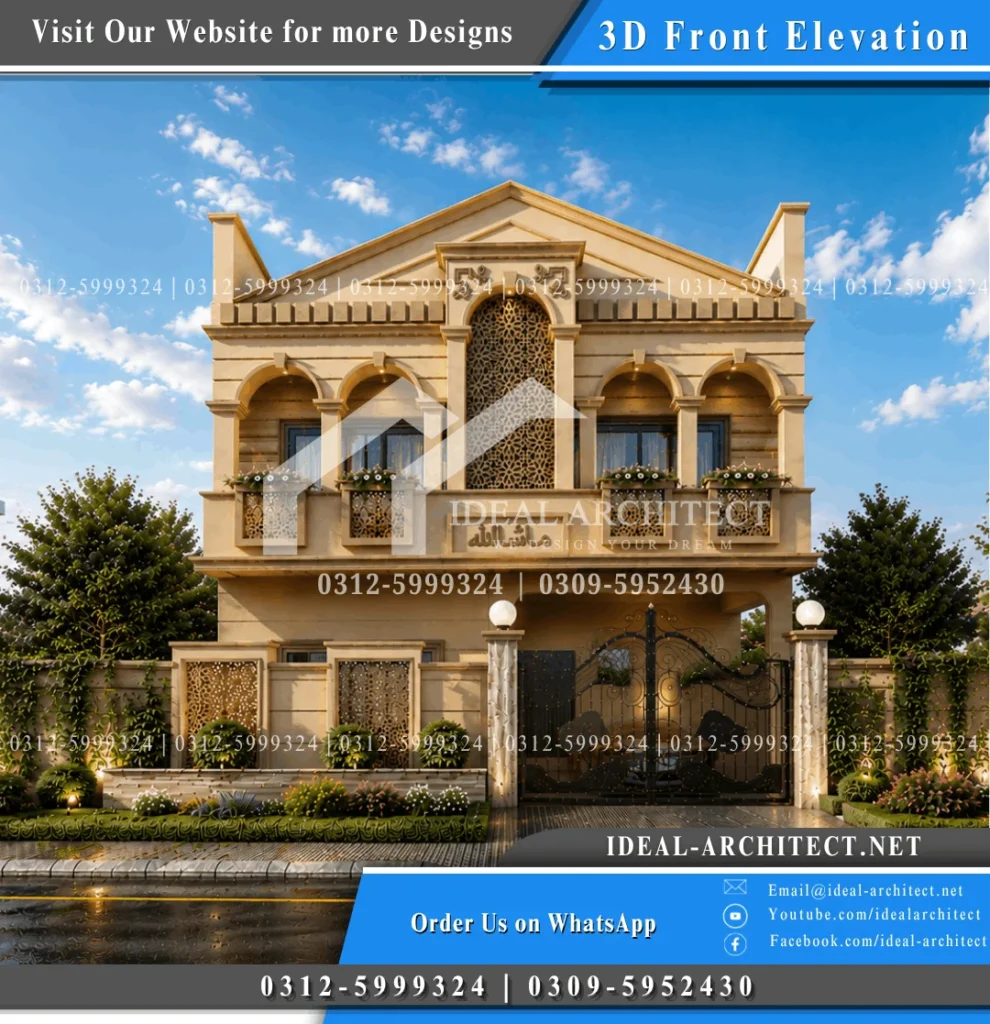
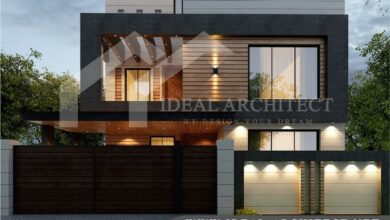
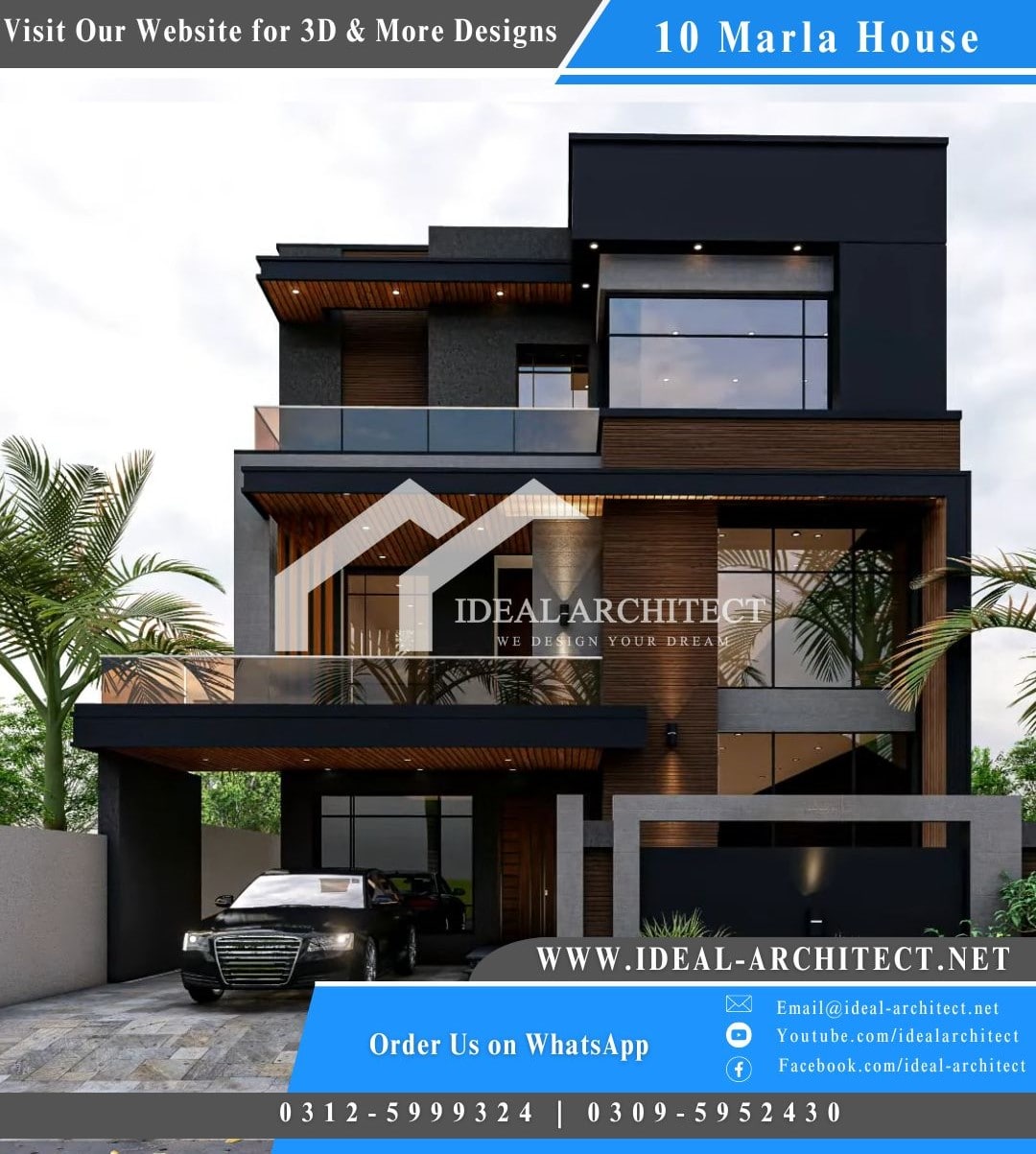
A 10 marla house plan 3d evaluation of this elevation reveals something that two-dimensional drawings cannot communicate — the quality of depth this facade produces under changing light conditions, and the way its material palette transforms between the harshness of midday sun and the warmth of golden hour. This is a facade designed to be observed from the street at different times of day, and it performs differently — and well — across every one of them.
The 10 marla front elevation operates on a colour palette that is deliberately restrained in variety and rich in material quality. The primary structural body is finished in a smooth high-grade exterior stucco in a warm desert-sand beige tone — a surface that absorbs changing daylight gracefully throughout the day rather than reflecting it harshly. As the light shifts from cool morning to golden afternoon, the same beige wall surface reads as three distinctly different shades without the colour itself changing. When the golden hour sun drops low, the warm tones of the masonry absorb the orange and gold hues from the sky and the house appears to glow from within — an effect that no purely white or dark facade can replicate under the same conditions.
10 Marla Front Elevation Design — Materials, Screens aur Colour Palette
The material strategy across this 10 marla front elevation design is built around a principle of targeted luxury spending — concentrating premium material cost on the elements that carry the most visual weight while keeping the primary structural surfaces cost-effective. The CNC-cut gold-toned geometric screens in the central arch, the four balcony balustrades and the two boundary wall niches are fabricated from powder-coated aluminium — a material that is completely rust-resistant, lightweight and maintains its gold finish without fading under intense Pakistani sunlight. These screens carry the entire luxury impression of the facade while the structural body beneath them is straightforward plastered masonry.
The wrought-iron main gate with its polished gold structural accents and curved filigree work follows the same principle — high visible impact, long-term durability, and a maintenance requirement limited to occasional rust-inhibitive painting rather than costly replacements. The stone-textured columns flanking the gate use a rough-hewn natural stone veneer or specialised textured concrete plaster that provides excellent resistance to physical wear at ground level while grounding the composition with a material that reads as heavier and more permanent than the smooth stucco above it.
The colour system across this 10 marla house front elevation uses four tones working in a carefully balanced relationship. Desert-sand beige covers the entire structural body — comforting, welcoming, and beautifully reactive to daylight shifts. Radiant gold and bronze metallic finishes on the screens and gate highlights lift the composition and add a layer of luxury without overwhelming the neutral base. Deep matte black on the gate frames and window mullions anchors the floating beige elements and provides sharp definition at the edges. Vibrant greens from the boundary planting and soft pinks from the balcony flowers complete the palette — organic accents that prevent the monochromatic stone tones from feeling static or lifeless.
Modern 10 Marla House Front Elevation — 3D Lighting aur Night View
The modern 10 marla house front elevation undergoes its most dramatic transformation after dark — and the evening reading of this facade is where the lighting design moves from functional to genuinely architectural. Warm LED downlights are recessed inside the crown of every single arch, casting a scalloped downward glow across the window openings and highlighting the structural pilasters at the sides of each alcove. This is not uniform floodlighting — it is accent lighting that works with the architectural forms rather than washing them out.
The backlit Jali screens in the boundary wall niches and the primary central arch feature hidden diffused LED strip lighting behind the geometric panels. After dark, this causes the intricate CNC-cut patterns to silhouette brilliantly against the night sky — the gold screen becoming a luminous surface that projects the geometric pattern outward as a light composition rather than a material one. The two spherical opal-glass globe lights atop the gate columns provide the ambient ground-level illumination for the driveway while functioning as the visual anchor points of the entrance composition at night.
For Pakistani homeowners looking at a spanish front elevation 10 marla reference alongside this design — it is worth noting that the Islamic Fusion style and the Spanish Mediterranean style share a deeper common ancestry than their surface differences suggest. Both traditions draw from Moorish architectural heritage — the same geometric screen work, the same round arch profiles, the same warm masonry palette and the same integration of courtyard greenery appear in both. The 10 marla house design pictures front view of this elevation would not look architecturally out of place alongside a high-quality Spanish residential facade. The CNC Jali screens here are a direct cultural relative of the Arabesque patterns found across Spanish Andalusian architecture.
The 10 marla house elevation is classified in the Premium Mid-Range budget tier despite its luxury appearance — a result of the material strategy described above. The primary structure uses high-quality plaster and exterior paint rather than full-body stone cladding, saving a significant portion of material and structural labour cost. The premium budget is concentrated on the CNC screens, wrought-iron gate and integrated LED lighting — the three elements that produce the most visual impact per rupee spent. Long-term maintenance across this 10 marla house plan 3d exterior is kept low through powder-coated metals and durable exterior stucco that resist Pakistan’s UV exposure, monsoon moisture and dust conditions without requiring frequent recoating or replacement.