10 Marla Ghar Ka Naksha — House Plan, Map aur 35×70 3D Elevation
10 Marla House Plan aur Map — Complete Layout Guide
Building a home on a 10 marla plot in Pakistan or 10 marla ghar ka naksha is one of the most significant financial decisions a family makes — and the floor plan is where everything either comes together or falls apart. A 10 marla house plan that looks clean on paper but creates circulation problems, poor privacy or wasted space in practice will frustrate a family for decades. This layout avoids those problems by treating room placement as the primary design decision, not an afterthought.
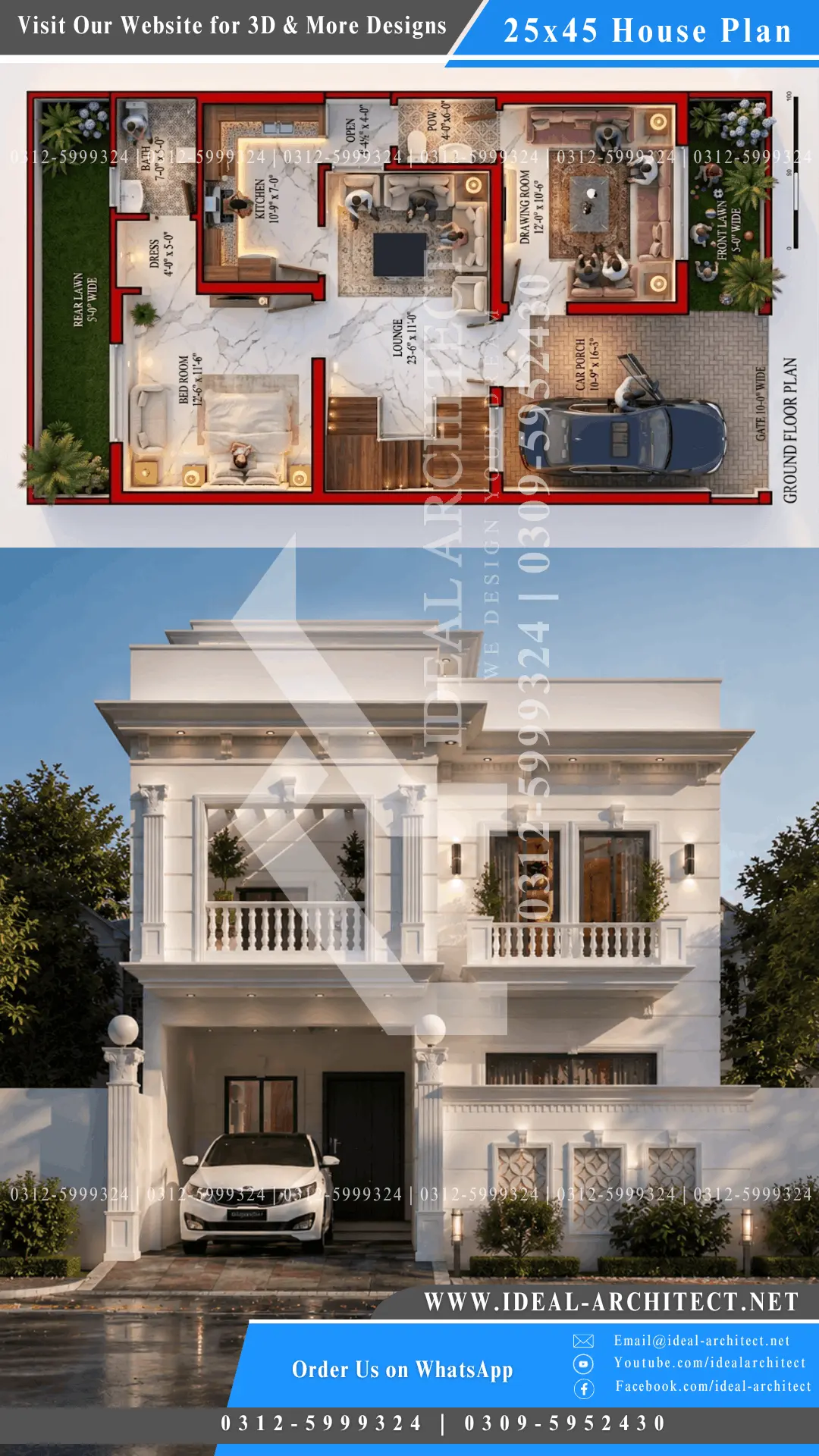
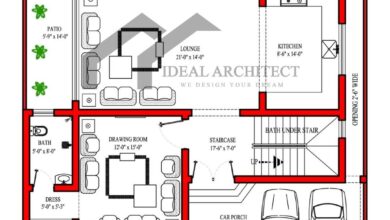
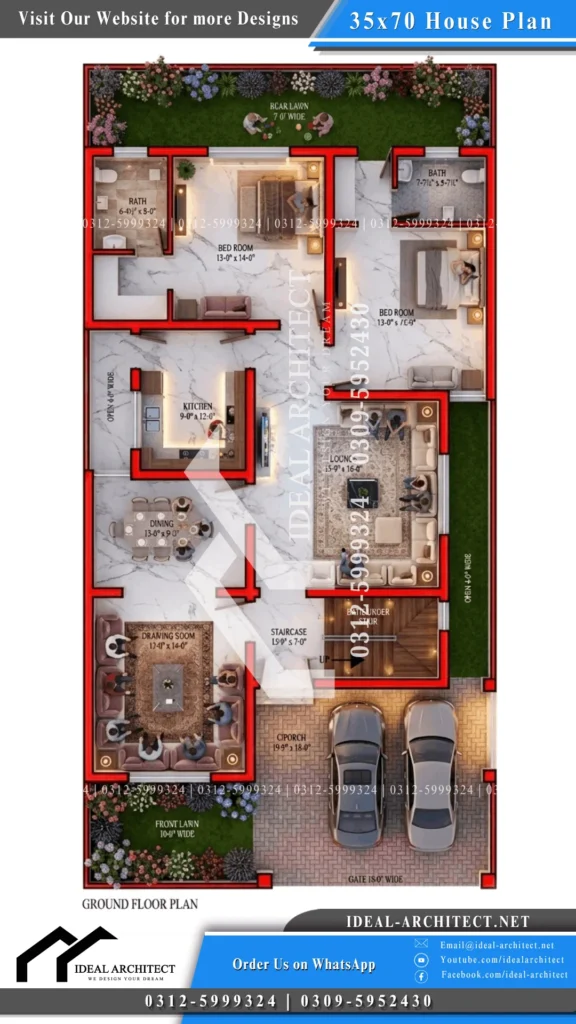
The plan opens from an 18-foot wide main gate. On the right, a 19′-9″ × 18′-0″ car porch handles two full-sized vehicles side by side with comfortable door clearance on both sides. On the left, a 10-foot wide front lawn stretches across the facade — a green buffer that separates the house from the street, absorbs road noise and gives the front of the property a clean, welcoming presence. These two front elements together establish the first impression of the home before anyone steps inside.
From the porch, the layout splits into two separate paths. Formal guests step directly into the 13′-0″ × 14′-0″ drawing room at the front left corner — a fully isolated reception space that keeps visitors completely out of the family’s private living areas. Family members enter through the staircase lobby on the right, which connects directly to the central family lounge without crossing the guest zone. This separation is one of the foundational decisions in this 10 marla house layout — in a household that regularly receives guests, it makes daily life significantly less disruptive.
10 Marla House Map Design — Room Layout aur Zoning
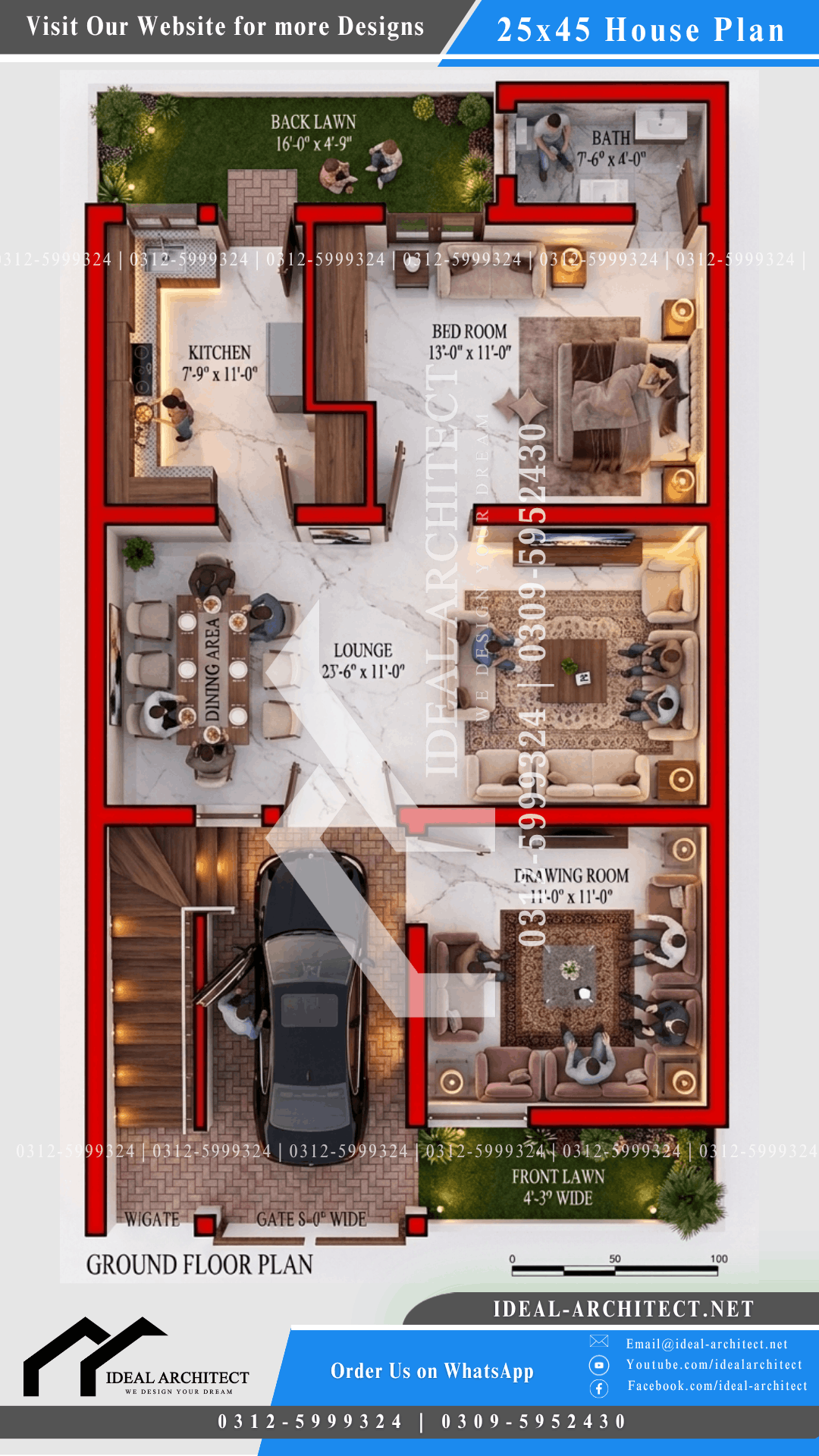
The family lounge at 15′-9″ × 16′-0″ sits at the central core of this 10 marla house map design, functioning as the hub from which every private room is accessible. Its width and depth allow for a full corner sectional sofa arrangement with a floating media wall and clear walking space on all sides. Wide windows facing the 4-foot wide side open passage on the left keep the room naturally bright throughout the day and maintain continuous cross-ventilation across the central living area.
The dining room at 13′-0″ × 9′-3″ sits at the mid-left zone, positioned between the drawing room, the kitchen and the lounge — exactly where it should be for a household that moves regularly between those three spaces. Meal service from kitchen to table involves minimal steps. The kitchen at 9′-0″ × 12′-0″ uses a modified U-shaped counter configuration that places the sink under the side passage window, the cooking hob on the inner wall and storage towers along the back wall — an efficient working triangle that keeps prep, cooking and washing within easy reach of each other. A secondary service door leads directly from the kitchen out to the 4-foot side alley, handling waste and deliveries without bringing utility traffic through the dining room.
A powder room tucked under the staircase serves as a guest bathroom off the main lobby — a practical use of what would otherwise be dead space beneath the steps. It keeps visitors out of the private bedroom bathrooms while remaining easily accessible from both the drawing room and the dining zone.
10 Marla House Map with 3 Bedroom — Rear Zone and Private Spaces
The rear of this 10 marla house map is reserved entirely for private family use. Two bedrooms sit at the back corners of the plot, separated from the guest zone and the kitchen by the full depth of the central lounge.
The left bedroom at 13′-0″ × 14′-0″ functions as the master suite — its en-suite bathroom at 6′-4½” × 8′-0″ is accessed through a dedicated dressing alcove that keeps the wardrobe space separate from the bathroom moisture zone. The bathroom vents through a high frosted window opening into the side alley for immediate steam extraction. The right bedroom at 13′-0″ × 14′-0″ mirrors the master exactly in floor area — both rooms carry identical dimensions, ensuring equal comfort for every family member occupying them. Its attached bathroom at 7′-7½” × 5′-7½” sits at the rear right corner with fixtures arranged efficiently along the outer plumbing walls.
Both bedrooms look directly onto the 7-foot wide rear lawn — a full-width open setback along the back boundary that provides fresh air through large rear windows, gives the bedrooms a quiet garden view and creates a secure private outdoor space away from street-level activity.
The staircase lobby at 15′-9″ × 7′-0″ sits at the front right, accessible from the car porch without entering the lounge or crossing the bedroom corridor. This placement is deliberate — if an upper floor is ever added to this 4 bedroom 10 marla house plan, it can operate as a completely separate unit with its own staircase access from the front, no shared internal path with the level below.
Natural ventilation across this 10 marla map design runs through four open zones — the front lawn, the 4-foot left side passage, the internal open-to-sky service shaft and the 7-foot rear lawn. Every room in the layout has a functional exterior window. No space in this 10 marla house plan ground floor depends on an exhaust fan as a substitute for real natural airflow.
10 Marla Ghar Ka Naksha — 35×70 House Plan Complete Guide
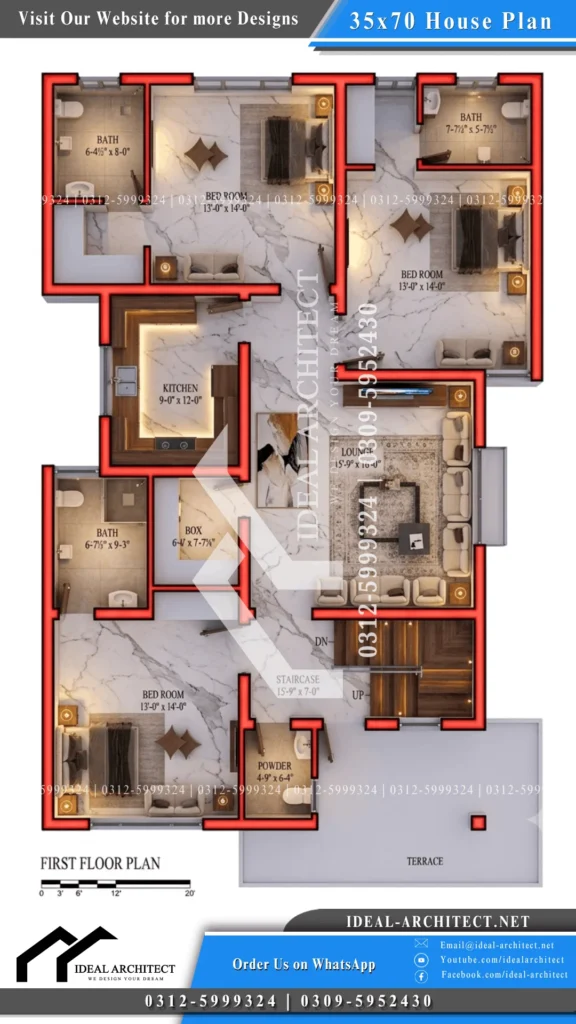
A well-planned 10 marla ghar ka naksha does not just add rooms on top of each other — it creates a complete residential unit on every level that a family can actually live in independently. Three bedrooms, a full kitchen, a wide central lounge, a powder room and a private front terrace all sit within the same 35×70 footprint as the level below, accessible from the staircase landing without any shared internal path with the level below.
This is the detail that makes a 35×70 house plan genuinely flexible over time. When the staircase lobby is closed off at the landing, the upper level functions as a completely self-contained unit — its own entrance, its own kitchen, its own living spaces. For a joint family in Pakistan, that separation means two households sharing a roof without sharing a front door. For a homeowner thinking ahead, it means a rental unit that requires no structural modification to create.
Arriving at the upper landing from the staircase at 15′-9″ × 7′-0″, the layout immediately branches into three directions. Straight ahead opens into the central family lounge. To the left, a doorway leads out to the open front terrace above the car porch. To the right, a dedicated powder room at 4′-9″ × 6′-4″ serves the landing and terrace without requiring access to any of the private bedrooms — a practical detail in any 10 marla makan ka naksha where guest movement needs to stay out of the private bedroom corridor.
Naqsha House 10 Marla — 35×70 Plot Layout aur Room Zoning
The front bedroom at 13′-0″ × 14′-0″ sits at the front left corner of this level, directly above the drawing room below. Its attached bathroom at 6′-7½” × 9′-3″ is the deepest bathroom in the house — generous enough for a full vanity, water closet and enclosed shower stall without any fixture feeling cramped. Wide windows connect directly to the open front terrace, giving this room the kind of morning light and elevated street view that makes it the most desirable bedroom in the entire 35×70 house design.
The central lounge at 15′-9″ × 16′-0″ mirrors the lounge below in both size and position — a structural decision that keeps all load-bearing walls aligned vertically and eliminates the need for expensive transfer beams. As the circulation hub of this naqsha house 10 marla, it connects all three bedrooms, the kitchen and the terrace from a single central point. No room on this level requires passing through another to reach it, which is the defining quality of a well-organised 10 marla plot ka naksha.
The kitchen at 9′-0″ × 12′-0″ occupies the mid-left zone, directly above the kitchen below. This vertical alignment in the 35×70 house plan keeps all plumbing in a single stack — water supply lines, drainage pipes and gas connections run straight up rather than branching horizontally through structural slabs. Construction cost goes down. Future maintenance becomes straightforward. A box room at 6′-0″ × 7′-7½” sits adjacent to the kitchen, providing a dedicated enclosed storage space for suitcases, seasonal items and household overflow — keeping every bedroom in this home naksha 10 marla clutter-free without sacrificing wardrobe space.
10 Marla House Map 35×70 — Rear Bedrooms and Ventilation
The rear section of this 10 marla house map 35×70 follows the same logic as the level below — both bedrooms at the back corners, fully private, away from staircase traffic and kitchen activity.
The rear left bedroom at 13′-0″ × 14′-0″ sits at the back left corner with its attached bathroom at 6′-4½” × 8′-0″ venting through a high-level window to the side open passage. The rear right bedroom at 13′-0″ × 14′-0″ mirrors it exactly in dimensions and position, with its attached bathroom at 7′-7½” × 5′-7½” using the rear open setback for ventilation. Both rooms look out onto the 7-foot wide rear lawn — the same quiet green setback that serves the lower bedrooms, now providing elevated views and better airflow.
The front terrace sits above the 19′-9″ × 18′-0″ car porch footprint — a wide open-to-sky space directly accessible from the staircase landing and the lounge entrance. In Pakistani households, an elevated outdoor space away from street level gets used far more consistently than ground-level sit-outs, particularly in the evenings. This terrace adds genuine daily usability to the upper level of this 35×70 house design without requiring any additional structural footprint beyond the porch slab already in place below.
Natural ventilation on this level benefits from the elevated position — the same four open zones continue upward. The 4-foot side passage, the internal open-to-sky service shaft and the 7-foot rear setback all continue their ventilation roles here, ensuring every room in this house naksha 10 marla receives natural airflow and real exterior window access throughout the day.
10 Marla Front Elevation — Modern House Design Pictures Front View
The front elevation of a 10 marla house in Pakistan does more work than most homeowners initially give it credit for. It is the first thing a visitor sees before stepping through the gate, the last thing a neighbour notices every time they pass, and the single biggest factor in a property’s long-term market value on any residential street. Getting the 10 marla front elevation right means making simultaneous decisions about massing, material contrast, depth and proportion — not treating any one of these as secondary to the others.
This elevation belongs firmly to the Contemporary Modern architectural language — a style gaining serious traction across premium Pakistani housing societies precisely because it ages well. Clean geometric massing does not go out of style the way decorative columns or classical arches do. High-quality natural material contrasts become more characterful over time rather than looking dated. Integrated landscaping matures and softens rather than degrading. These are the qualities that make this 10 marla house front elevation a worthwhile long-term investment rather than a short-term aesthetic choice.
10 Marla House Front Elevation Design — Massing, Depth and Composition
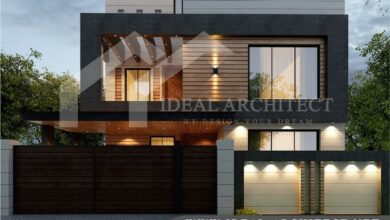
The facade of this 10 marla house front elevation design is structured around a deliberate push-and-pull of architectural planes — certain volumes projected forward, others recessed behind them — creating shadow lines and visual depth that make the elevation read as three-dimensional even in flat, overcast light. A heavy dark charcoal rectangular frame dominates the upper portion of the facade, projecting forward from the building line and acting as the primary visual anchor for the entire composition. Inside this frame, horizontal timber cladding panels cover the central feature wall — their warm linear grain providing a direct material contrast to the cool, dark weight of the surrounding frame.
The car porch sits below as a wide column-free span, its ceiling clad in warm wood panels that continue the material language from the upper frame downward. The main entrance door is recessed deeply inside the porch — sheltered from rain and direct sunlight by the cantilevered concrete slab above. Large floor-to-ceiling windows with dark anodised aluminium frames complete the openings across both levels, providing maximum glass area while keeping the profile minimal and contemporary.
At the uppermost level, the elevation steps back to reveal an open terrace lined with built-in rectangular planters. The main wall at this level is finished in a light cream tone with a row of small recessed architectural niches that break the surface without adding decorative ornamentation. The very top of the structure is capped with a terracotta-tiled hip roof featuring a deep timber-clad overhang — a traditional element introduced deliberately at the peak to prevent the composition from reading as cold or clinical.
The boundary wall mirrors the main house in material and language — a low cream base with a taller stone-clad frame on the left, a timber-slat gate set within a dark metallic frame, and a secondary pedestrian door for daily use. From the street, the property reads as a cohesive, unified composition rather than a house behind a wall.
Modern 10 Marla House Front Elevation — Spanish Style aur Material Contrast
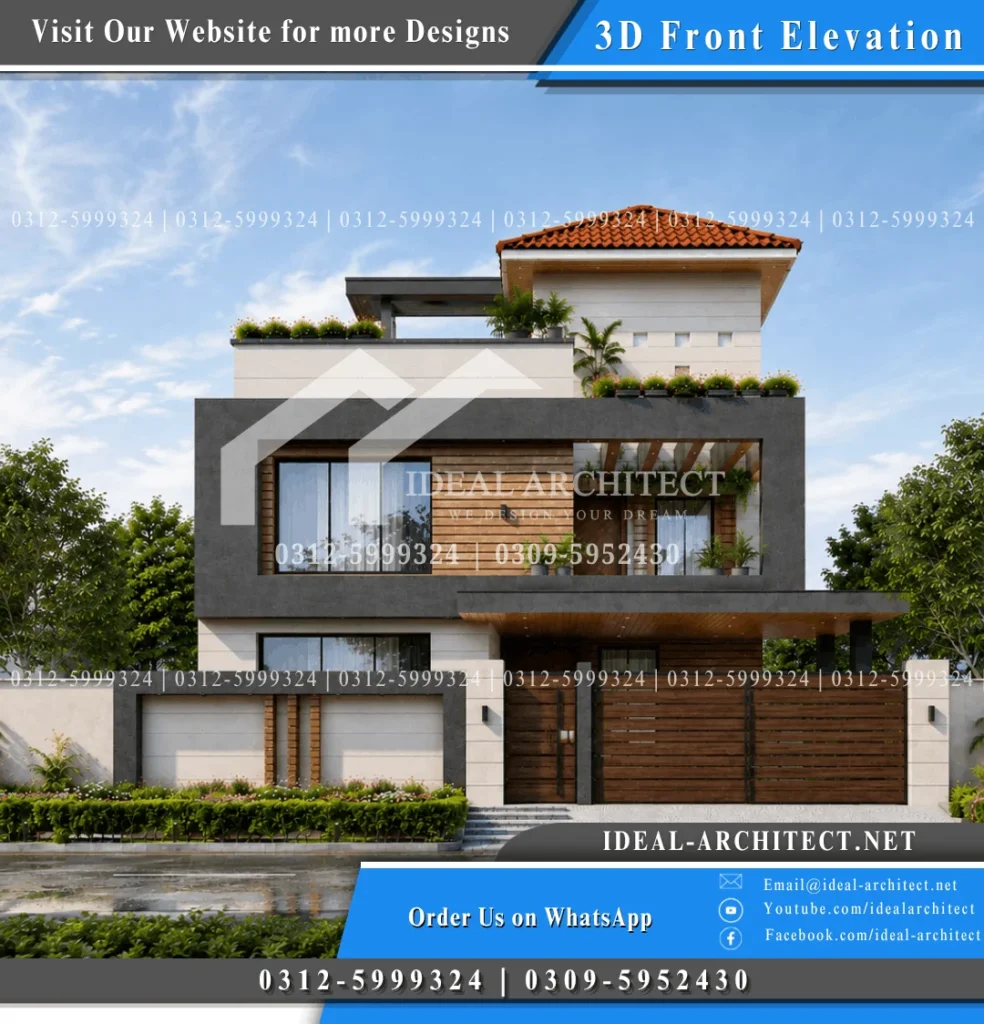
The material palette of this modern 10 marla house front elevation operates on a three-tone system that produces a sophisticated warm-versus-cool contrast across the entire facade. Dark charcoal textured stone tiles cover the primary structural frame — their matte, split-face surface absorbing light and making the form appear grounded and heavy. Horizontal WPC or HPL timber cladding panels in warm teak tones occupy the central feature wall and porch ceiling, introducing an organic warmth that prevents the dark frame from reading as industrial. Cream porcelain cladding covers the background surfaces, upper tier walls and boundary pillars — a smooth, light-reflective backdrop that allows the richer textures to stand out clearly against it.
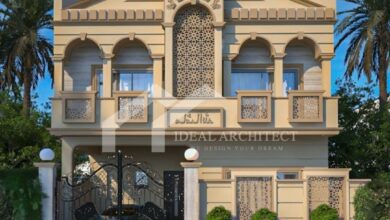
For families considering a spanish front elevation 10 marla as an alternative direction — the underlying structural massing of this composition adapts directly. The dark charcoal frame becomes warm terracotta-toned cladding. The timber panels shift to textured plaster with Moorish detailing. The overall palette moves from cool-warm contrast to a fully warm Mediterranean register. The geometry — projecting frame, recessed volume, cantilevered slab, stepped upper tier — stays structurally identical. What changes is the surface language, not the architecture beneath it.
The 10 marla house design pictures front view of this elevation show three specific material details that carry the most visual weight. The horizontal linear grain of the timber cladding creates a rhythm of fine shadow lines across the feature wall throughout the day as the sun moves — a surface that changes character from morning to afternoon without any additional intervention. The rough split-face texture of the dark stone frame catches grazing light at low sun angles, producing deep micro-shadows that emphasise the stone’s premium quality. The smooth cream cladding behind both of these surfaces acts as a neutral foil, giving both textures a clear background to read against.
10 Marla House 3D Design — 35×70 House Plan 3D Complete View
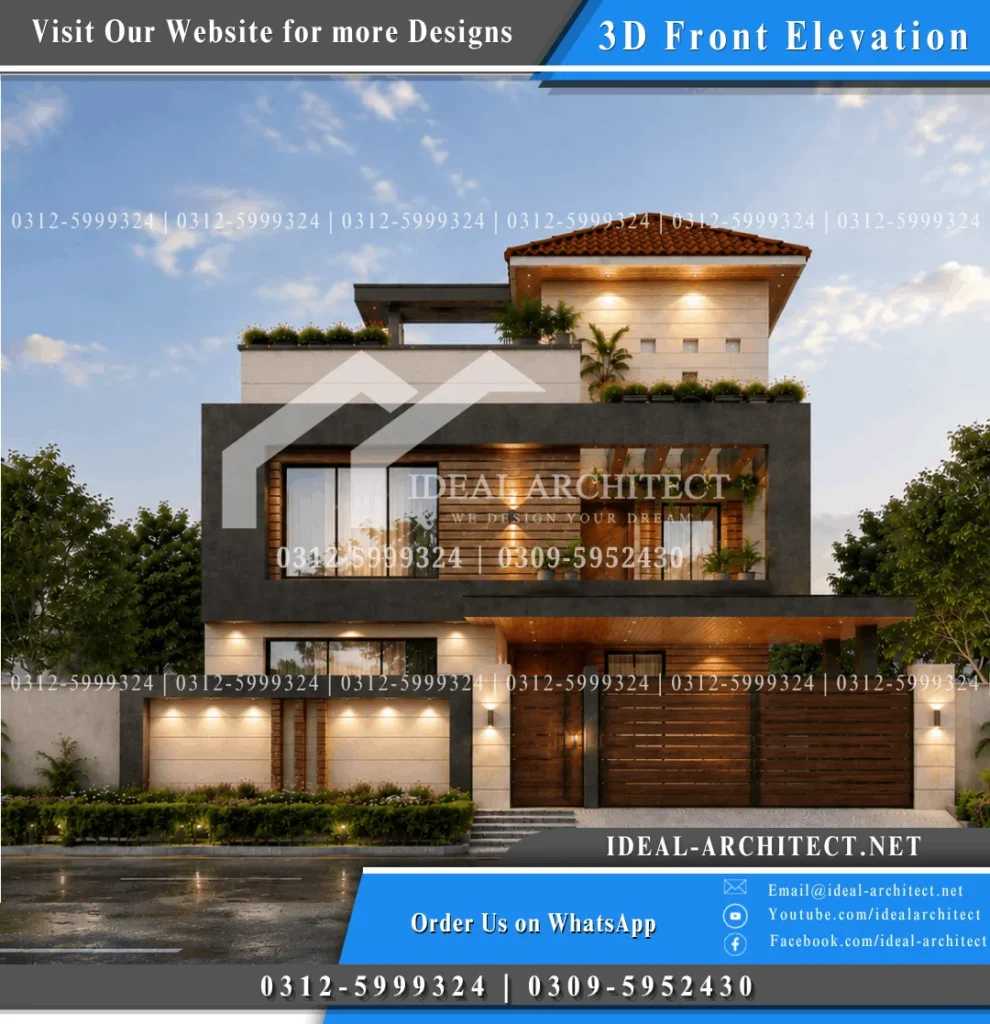
A 3D rendering of a 10 marla house 3d design does something a floor plan cannot — it shows a family what they are actually committing to before a single brick is laid. Proportions that look correct on a two-dimensional drawing can read very differently as a three-dimensional volume, and materials that seem compatible on a specification sheet can clash badly when rendered together under natural light. This 35×70 house plan 3d evaluation covers both the daytime and evening reading of the elevation, because a premium exterior in Pakistan needs to perform under both conditions.
10 Marla House Plan 3D — Daytime Massing aur Visual Hierarchy
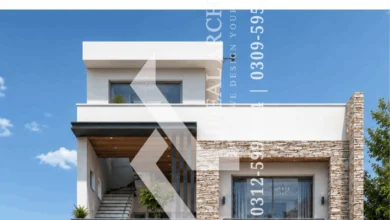
Under direct daylight, the 10 marla house plan 3d composition reads through a clear visual hierarchy that moves the eye upward in a deliberate sequence. The boundary wall and gate at street level establish the material language — cream base, dark stone frame, timber slat gate — and communicate the quality of what sits behind them before anyone enters the plot. The car porch at the base of the main structure provides a wide, sheltered transition zone with a warm wood ceiling that draws the eye inward toward the recessed entrance door.
The dominant dark charcoal rectangular frame above the porch projects forward and immediately draws attention to the main facade. Inside this frame, the horizontal timber cladding on the feature wall provides the strongest texture contrast in the composition — its warm linear grain working directly against the cool, dark weight of the surrounding stone. Large floor-to-ceiling windows with black aluminium frames sit to the left of the timber wall, giving the interior spaces direct visual connection to the front terrace and street beyond.
The composition steps back at the upper level to the lighter cream-toned tier with its recessed niches, and terminates at the very top with the terracotta-tiled hip roof and its deep timber-clad overhang. This stepping movement — from projected dark mass at mid-level to recessed light surface at the top — gives the 35×70 house plan 3d its sense of upward movement without requiring the building to be taller than its neighbours.
35×70 House Plan 3D — Evening Lighting aur Night Elevation
The same 35×70 house plan 3d undergoes a complete transformation after dark — and the evening reading of a premium Pakistani residence is as important as the daytime one, because most guests arrive and neighbours observe in the evening hours.
The exterior lighting strategy across this 10 marla house design 3d operates in three separate layers that work simultaneously rather than in sequence. The first layer is ambient — flush warm LED spotlights mounted in the wood-clad porch ceiling cast a wide, even pool of light across the driveway and pedestrian entrance, ensuring safe navigation and eliminating dark corners near the gate. The second layer is accent — surface-mounted up-down sconces on the timber feature wall throw V-shaped beams upward and downward simultaneously, grazing the horizontal panel joints and making the linear grain visible in sharp relief at night. The third layer is architectural — concealed spotlights under the terracotta roof overhang wash warm light down the upper cream walls, ensuring the full height of the 10 marla house elevation remains readable against the night sky rather than disappearing into darkness above the main frame.
On the boundary wall, recessed wall-washing lights bathe the cream pillar surfaces in a soft glow while up-down sconces on the stone frames flank the gate entrance — creating a clearly lit arrival sequence that reads as welcoming rather than institutional. The large glazing units on the main facade allow warm interior ambient light to filter outward at night, giving the windows a soft, inhabited glow rather than reading as dark voids from the street.
The upper terrace planters are lit from below through concealed fixtures hidden behind the planter boxes — the leaves and fronds of the low-maintenance palms and shrubs become dark, intricate silhouettes against the warm illuminated wall surfaces behind them. This detail bridges the gap between the building’s hard geometric surfaces and the organic softness of the landscaping in a way that no daytime view achieves, and it is consistently one of the most noticed qualities in any high-quality 10 marla house design pictures front view Pakistan after dark.
All exterior lighting fixtures specified for this 10 marla house 3d design carry a minimum IP65 weatherproof rating — mandatory for Pakistan’s monsoon season and dust conditions. Warm-spectrum LEDs at 3000K to 3500K colour temperature are used throughout, preventing the contemporary architecture from reading as cold or clinical under artificial light while keeping long-term electricity consumption low.